
Economical Formwork Boards for Short-Cycle Concrete Projects
Short-cycle concrete projects need panels that perform reliably across a limited number of pours without carrying the cost of high-grade reuse materials. Dongstar Wood publishes a product with a melamine bond that passes a 10 Hours Boiling Test, acacia core from Vietnamese plantation forests, and a reuse expectation of approximately 3-5 times under normal site conditions.
Key takeaways
- Melamine bond passes a 10-hour boiling water test, providing moisture resistance for standard pours.
- Acacia core from Vietnamese plantation forests delivers stable performance at an economical price point.
- Best-selling thickness for European buyers is 21 mm, followed by 18 mm.
- Most requested size for European distribution is 1250 × 2500 mm.
What "economical" means in formwork terms
The word economical in formwork does not mean the lowest-cost panel per sheet. It means the lowest cost per pour across the project lifecycle. A panel that costs less per sheet but survives only one pour is more expensive per pour than a panel that costs more per sheet but survives three pours. The buyer who compares panel cost without considering the number of reuse cycles arrives at the wrong number, and the project budget absorbs the difference.
Dongstar Wood positions its Black Film Faced Plywood as the economical option for projects where the panel will be reused a limited number of times. The published reuse expectation is approximately 3-5 times under normal site conditions, which places this product in the middle of the formwork economy: more durable than a single-use panel, but less expensive than a high-grade panel rated for 10-20 pours. For short-cycle projects - residential slabs, small commercial floors, temporary structures - the 3-5 pour window covers the typical requirement without paying for capacity the project will not use.
The melamine bond and what it delivers
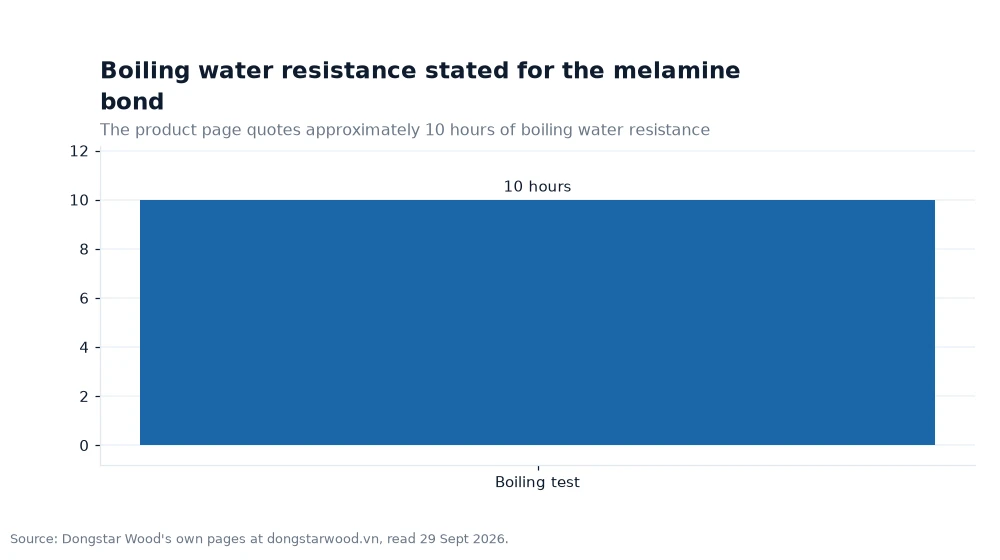
The adhesive is the component that determines how a formwork panel handles moisture, and the melamine bond on this product is tested to approximately 10 hours of boiling water resistance. That test number means the panel can withstand sustained exposure to wet concrete and cleaning water without the adhesive failing, which is the performance baseline for standard concrete pours. For projects where the panel will be exposed to rain during storage or left wet between pours, the melamine bond provides the moisture resistance needed to prevent delamination.
The 10-hour boiling test is a published specification, not a claim, and it sits alongside the adhesive range that covers E0, E1, E2, MR, WBP and Phenolic Dynea across the product line. For buyers who need higher moisture resistance — bridge decks, tunnel linings or projects in tropical climates with heavy rainfall — the WBP or Phenolic options provide a longer protection window, but they carry a cost premium that short-cycle projects do not always justify.
Acacia core: the structural backbone
The core of this product is made from acacia veneers sourced from Vietnamese plantation forests. Acacia is a dense hardwood that provides the stiffness and load capacity that formwork panels require, and its availability from plantation sources means the supply is sustainable and the cost is stable. The acacia core resists compression and bending, which are the two forces a formwork panel faces during a concrete pour: the weight of the wet concrete pushes down, while the support structure pushes up from below.
Bonding the acacia core consistently across each panel depends on a four-stage production sequence: moisture-controlled drying of the veneer, multi-layer panel assembly with alternating grain, high-pressure hot pressing under controlled temperature and quality inspection before shipment. Batch inspection items include panel thickness consistency and core construction integrity, which are the two quality checks that matter most for formwork performance. A panel with inconsistent core thickness will deflect unevenly under load, producing a wavy concrete surface that requires additional finishing.
Thickness and size for European buyers
The best-selling thickness for European buyers is 21 mm, followed by 18 mm. The 21 mm panel handles the heavier loads that European construction standards demand, and it provides the stiffness needed for floor slabs and wall pours where the concrete height exceeds two metres. The 18 mm panel serves lighter applications — residential floors, partition walls and small commercial slabs — where the load is moderate and the pour height is within normal range.
The most requested size for European distribution is 1250 × 2500 mm, which is slightly larger than the standard 1220 × 2440 mm sheet. The extra 30 mm in width and 60 mm in length provides additional coverage per sheet, which reduces the number of joints on the formwork surface and the amount of sealing tape required. For a floor slab measuring 10 m × 8 m, the 1250 × 2500 mm sheet covers 3.125 m², and the slab requires 80 ÷ 3.125 = 25.6 sheets — meaning 26 sheets minimum, compared with 27 sheets for the standard size.
| Specification | Published value | Why it matters |
|---|---|---|
| Best-selling thickness | 21 mm | Handles heavier European construction loads |
| Second thickness | 18 mm | Serves residential and light commercial pours |
| Most requested size | 1250 × 2500 mm | Covers more area per sheet, fewer joints |
| Reuse expectation | 3–5 times | Matches short-cycle project requirements |
| Boiling test | ≈10 hours | Confirms melamine bond moisture resistance |
Worked example: cost per pour across panel grades
A short-cycle project requiring 500 m² of formwork contact area compares two panel options. Option A: the economical product at 1250 × 2500 mm (3.125 m² per sheet), reused 3 times. The project needs 500 ÷ 3.125 = 160 sheets for a single layer, and those 160 sheets provide 160 × 3 = 480 m² of contact area across three pours — close to the 500 m² requirement, so the buyer orders 168 sheets to cover the full area. Option B: High-grade film faced plywood at the same size, reused 10 times. The same 500 m² requirement needs 500 ÷ 3.125 = 160 sheets for a single layer, and those 160 sheets provide 160 × 10 = 1,600 m² of contact area — far more than the project requires.
The economical choice is Option A, because the project uses the panel three times and discards it, while Option B provides seven unused pours of capacity that the buyer pays for but does not use. For a project with 10 or more pours, the calculation reverses: Option B delivers a lower cost per pour because the higher panel price is spread across more cycles. The product page publishes the reuse expectation and the boiling test result, and the film faced range covers the high-grade alternative for projects that need more than five pours.
Frequently asked questions
How many times can ordinary black film faced plywood be reused?
Under normal site conditions, the published reuse expectation is approximately 3–5 times. How many pours a panel survives depends on stripping, cleaning and storage care between pours, and on whether the film surface is damaged during handling. Projects that handle panels gently and store them undercover between pours will reach the upper end of the range.
What makes this panel suitable for European buyers?
The best-selling thickness of 21 mm meets European construction standards for floor slabs and wall pours, and the most requested size of 1250 × 2500 mm provides coverage that aligns with European formwork systems. The melamine bond passes a 10-hour boiling test, which confirms moisture resistance for standard pours, and the acacia core from Vietnamese plantation forests provides a stable, sustainable supply chain.
Is a trial order subject to a minimum volume?
No. The stated monthly capacity is the most the factory can ship, not the least it will take. Buyers often open with a few containers to check how the panels are packed and how flat they stay in transit before scheduling a monthly programme.
Matching panel grade to project duration
Short-cycle projects need panels that perform for a defined number of pours, and the economical choice is the panel whose reuse window matches the project timeline. The product specification page covers what the board can do; the company profile reveals the factory scale and the certificates held. Confirm both before committing to a formwork order.
The figures shown were compiled from the vendor's online documentation examined 29 Sept 2026[1].